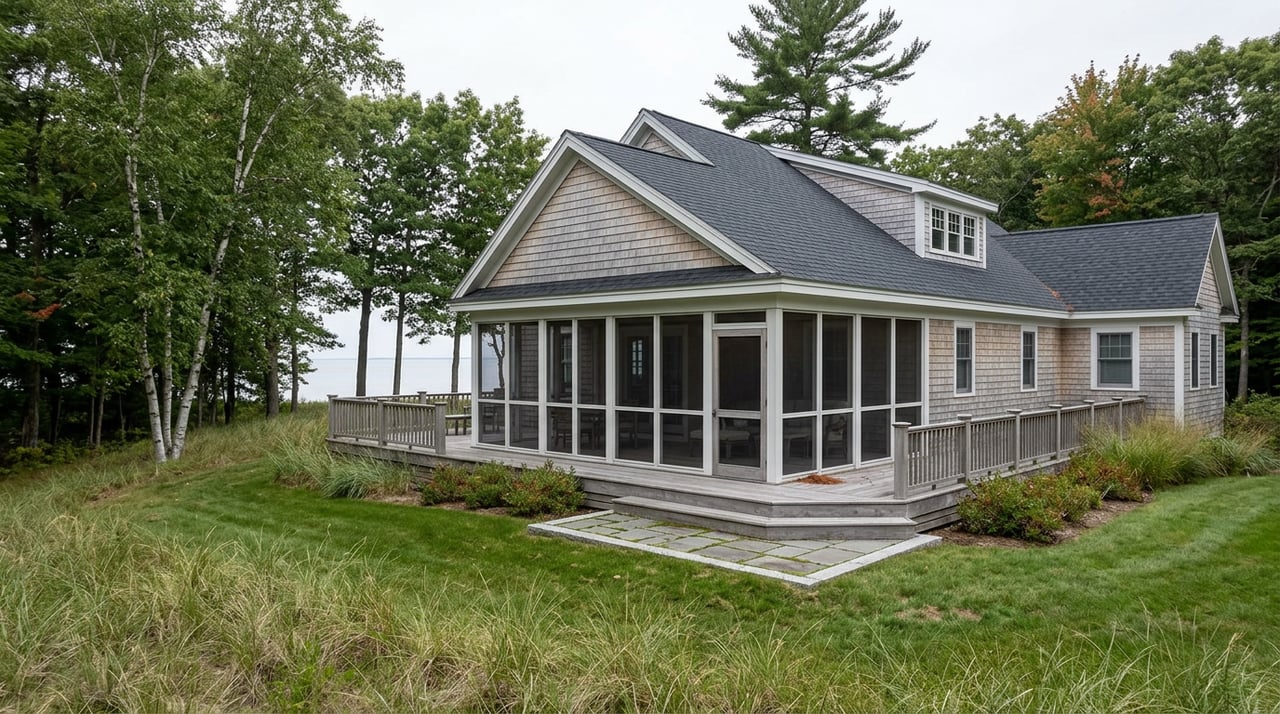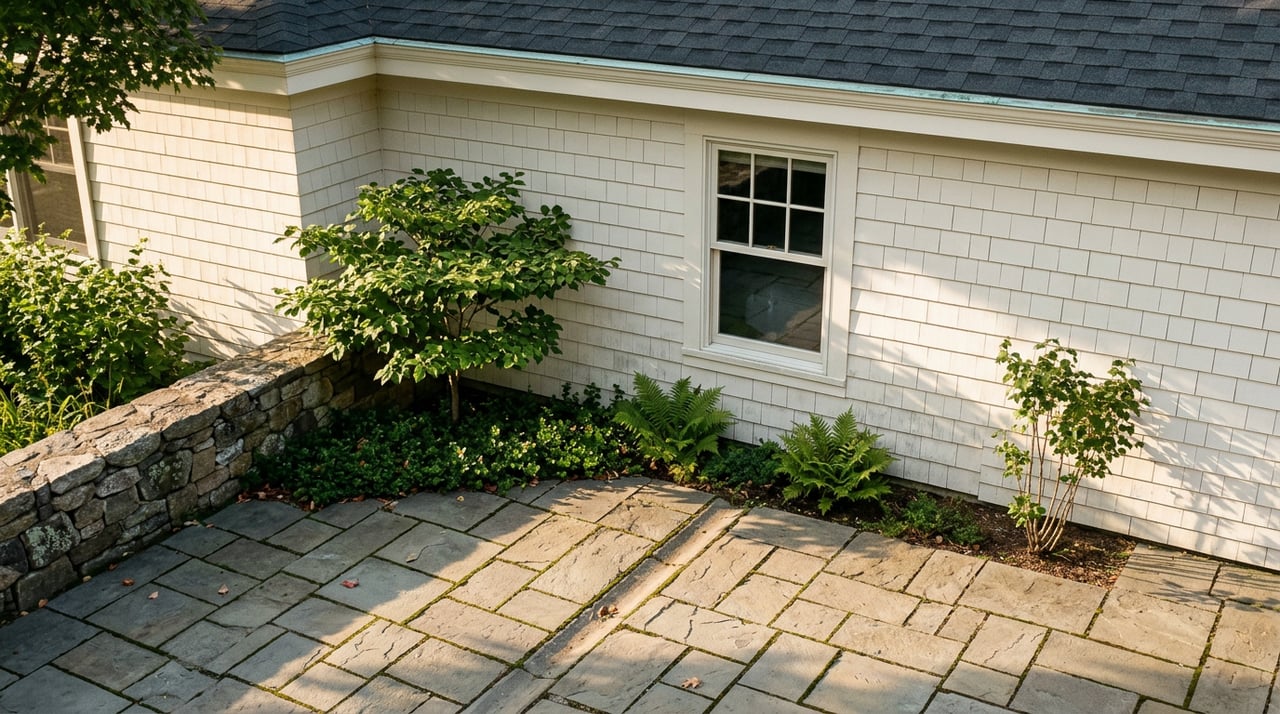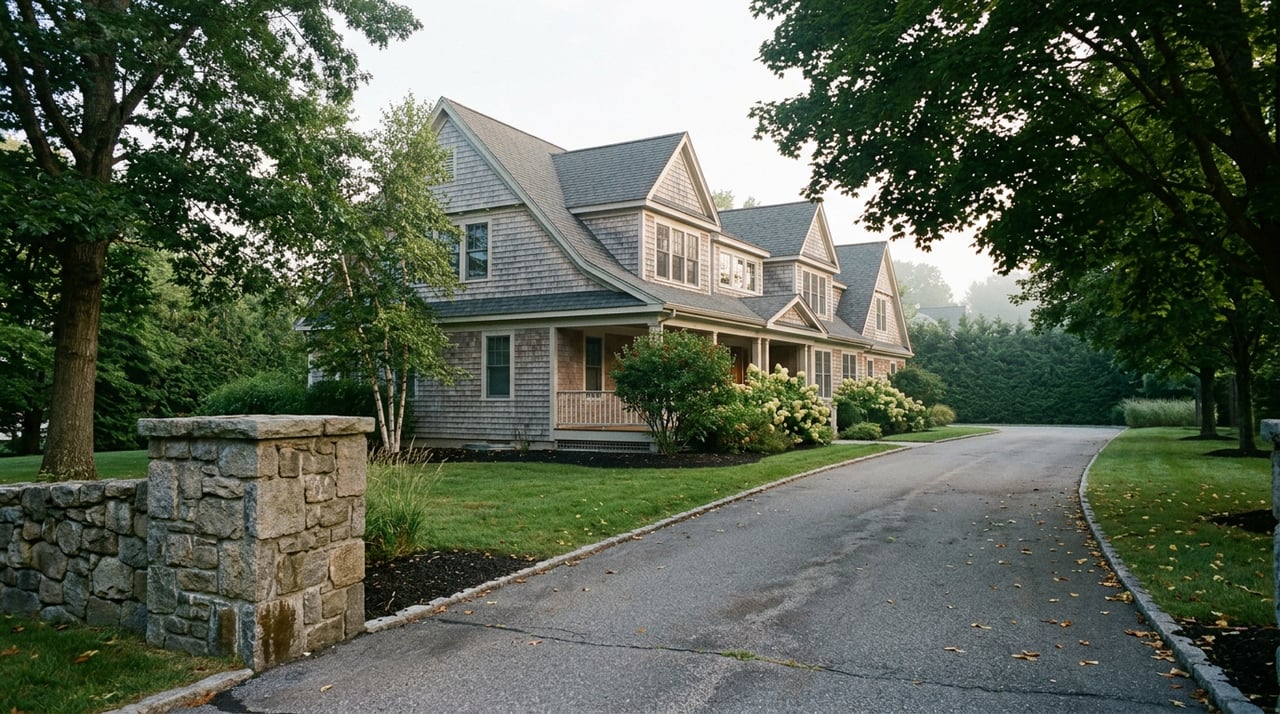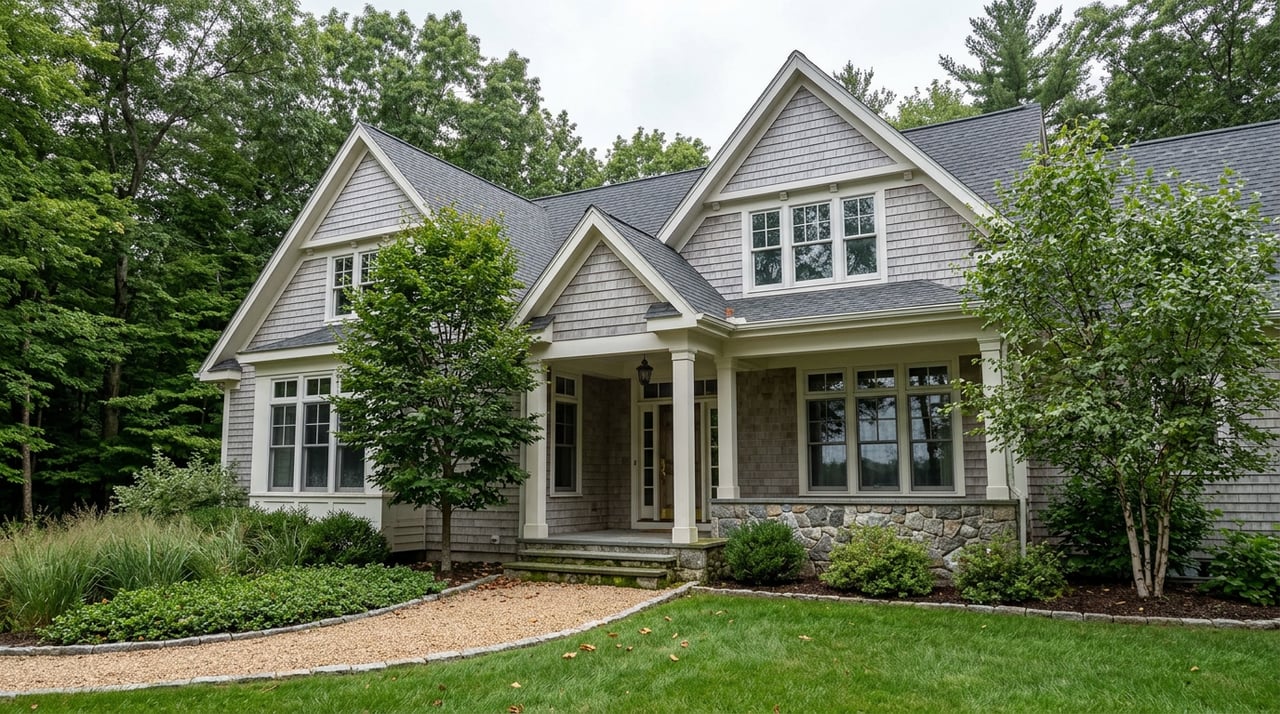
Two listings went up in Empire this summer within a few blocks of each other, priced within a few thousand dollars of one another. One sits inside the village core, close enough to walk to the Philip A. Hart Visitor Center, on the village's municipal water system. The other sits a short drive east in Empire Township, on a private well, with a septic system that will need a time-of-transfer evaluation from the county health department before the sale can close. Same price range. Same season. Completely different closing timeline, and a different set of ongoing obligations for whoever buys it.
That gap between what a price tag says and what it actually means is the whole story of Empire real estate right now, and it shows up in the market data too, not just in individual listings. As of August 2026, homes listed in Empire carried a median price of $635,000, down 2% from a year earlier. In that same window, the median price per square foot fell 12%. Days on market held steady at 88, unchanged from August 2025. One number says the market softened slightly. Another says it softened a lot. A third says nothing changed at all. None of those statements is wrong. They're describing different things, and the reason they diverge tells you more about Empire than any single one of them would on its own.
Two Numbers, One Contradiction
Do the arithmetic on those two Empire figures and something interesting falls out. If the typical sale price dropped only 2% while the price per square foot dropped 12%, the homes that actually sold this year were meaningfully larger than the ones that sold the year before, roughly 11% bigger by square footage, for close to the same money. That's not a market getting cheaper. It's a market where the mix of what's available to buy has shifted, and buyers are absorbing whatever fits that mix rather than choosing freely from a stable menu of options.
Zillow's separate estimate of average home value in Empire, $614,331, up just 1.1% over the past year, tells a quieter story at the aggregate level. Broad value is holding close to flat. It's the composition underneath that's moving, not the overall level. In a market with only a few dozen transactions a year, that kind of shift is easy to miss if you're only watching the median headline. It's the difference between a market that's actually repricing and a market where the available inventory itself has changed shape.
For a buyer comparing Empire against Suttons Bay or Lake Leelanau, this matters. A single quarter's median swing in a thin market like Empire's isn't a trend you can extrapolate. It's a snapshot of whatever specific handful of houses happened to close. The more useful question isn't "did prices go up or down," it's "why is the available inventory behaving this way in the first place." That answer has almost nothing to do with interest rates or buyer demand and almost everything to do with a boundary line drawn more than fifty years ago.
Where the Land Actually Went
Sleeping Bear Dunes National Lakeshore was established in 1970, protecting a stretch of Lake Michigan coastline that runs roughly 35 miles along with North and South Manitou Islands. Empire Township sits largely inside that boundary, and the village of Empire itself hosts the park's headquarters. Since the park's creation, the National Park Service has steadily acquired private land inside its boundaries, a process that has never really stopped. Near Big Glen Lake, just north of Empire, only four privately owned parcels remain along a full mile of shoreline that the Park Service has otherwise assembled acre by acre since 1970. In August 2024, the National Park Service formally requested help acquiring additional property specifically within Sleeping Bear Dunes in Empire, a request the nonprofit National Park Trust took on.
Every acre that moves from private to federal ownership is an acre that leaves the market permanently. It can't be rezoned back, subdivided, or listed again. That's a different kind of scarcity than what you'd find in a town where low inventory reflects a temporary lull in construction. In Empire, the ceiling on private land has been getting lower for more than fifty years, and it only moves in one direction. That's the real explanation behind the compositional shift in the price data: when the pool of buildable, sellable land shrinks steadily over decades, what's actually available to buy in any given year becomes less predictable and more dependent on whoever happens to sell, not on what a typical buyer would prefer to choose from.
The House You're Buying Depends Which Side of a Line It's On
Empire's land constraint doesn't just cap the total supply. It also splits what remains into two very different ownership experiences, depending on whether a property sits inside the Village of Empire or out in Empire Township.
| Village of Empire | Empire Township | |
|---|---|---|
| Water | Municipal system | Private well |
| Wastewater | Village service | On-site septic, transfer evaluation required at sale |
| Short-term rental | Village has circulated its own draft registration process | Zoning ordinance defines short-term rental as a 1 to 21 day stay, with parking and vegetated-buffer requirements |
| General setting | Compact, walkable, close to services | Larger lots, more rural, more privacy |
Two homes that look nearly identical in a listing photo can carry very different real costs and real limitations. A township property on a private well and septic system needs a transfer evaluation before the sale finalizes, and any prior work on that system, replacements, permits, changes in bedroom count, becomes part of the due diligence a buyer needs before closing, not after. A village property skips that step but may face a different, still-developing set of short-term rental registration rules. Neither situation is better across the board. They're just different enough that the sale price alone tells you almost nothing about what you're actually taking on.
The Best Evidence the Scarcity Is Real
If you want proof that Empire's land shortage isn't a rhetorical device, look at how the people trying to solve the local workforce housing shortage are structuring their solution.
The Sleeping Bear Gateways Council traces its roots to a citizens' advocacy group formed in the 1960s in direct response to the creation of Sleeping Bear Dunes National Lakeshore, when local landowners organized to represent their interests as the federal boundary took shape. Today the council is trying to solve a different problem born from the same constraint: teachers, first responders, and healthcare workers who can't find housing they can afford anywhere near where they work.
The council's current proposal, presented jointly to the Empire Village and Township councils, asks for something notable. Not to buy land outright, but to lease it. The plan covers up to 40 acres of jointly owned village and township property, structured as a 99-year land lease, with a first phase of 10 acres if both municipalities agree to move forward. Both bodies have already voted to form an Exploratory Committee to work through the details. Separately, the council has been pursuing four candidate properties, three in Empire Township and one in neighboring Kasson Township, after raising roughly $600,000 toward land acquisition, according to reporting from the Leelanau Ticker in October 2025.
The council's own position on the arrangement is that a community land trust structure keeps land off the open market permanently while keeping it fully on the tax rolls. The home built on the land is taxed like any other residential property, the homeowner pays standard property taxes, and the land itself simply can't be resold at market rate later, which is what keeps it affordable for the next family and the one after that.
A well-funded, community-backed nonprofit choosing to lease land for nearly a century instead of simply buying it outright isn't a financing preference. It's a workaround built for a place where buildable acreage is the actual constraint, not the capital to purchase it. If money alone could solve Empire's land shortage, this group wouldn't need a 99-year lease structure to get ten acres. That single design choice tells you more about how tight Empire's land supply really is than any listing count ever could.
What This Means If You're Comparing Empire to the Rest of the County
If you're weighing Empire against Suttons Bay, Leland, or Lake Leelanau, treat any single median-price headline with some suspicion. Watch price per square foot and days on market together, not separately, because in a market this thin, they can tell contradictory stories in the same quarter without either one being wrong. And before you compare a listing's price to anything else, find out which side of the village and township line it sits on. That one detail changes your water source, your wastewater obligations, your rental flexibility, and the timeline to closing.
A Few Questions Worth Asking Before You Look Further
Does being near the national lakeshore boundary limit what I can build on my own property? Properties near the shoreline or adjacent to park land often carry additional site review, including setback distances, slope limits, and vegetation requirements, on top of standard township or village zoning. Confirm these before assuming a renovation or addition will fit as planned.
Will the land trust homes affect resale values nearby? The structure keeps land on the tax roll and taxes the home itself at standard residential rates, so it isn't designed to remove value from the surrounding tax base. Eligibility for the homes themselves is limited to people who live and work in the community, which keeps that inventory in a separate lane from the open second-home market.
Is Empire's median price actually rising or falling right now? As of August 2026, the honest answer is both, depending on which number you look at. The median list price is down slightly, price per square foot is down more sharply, and the pace of sales hasn't changed. That combination points to a shift in what's selling, not a clean trend in either direction.
Empire's numbers don't behave like a typical market's because Empire isn't a typical market. It's a village where the available land has been narrowing for more than fifty years, one federal acquisition at a time, and where even a nonprofit with real money had to lease instead of buy. If you're trying to make sense of what a specific Empire property, or the choice between Empire and another Leelanau village, actually means for your plans, Peter Fisher can walk through the details that don't show up in a listing sheet, from which side of the village line a parcel sits on to what its septic history will require before closing. Reach out to schedule a Leelanau County consultation.